Your money is personal. Here's exactly how we protect it.
Notch was built so you never have to trade privacy for clarity. Here's what we do, what we never do, and what's always in your control.
Read-only, always
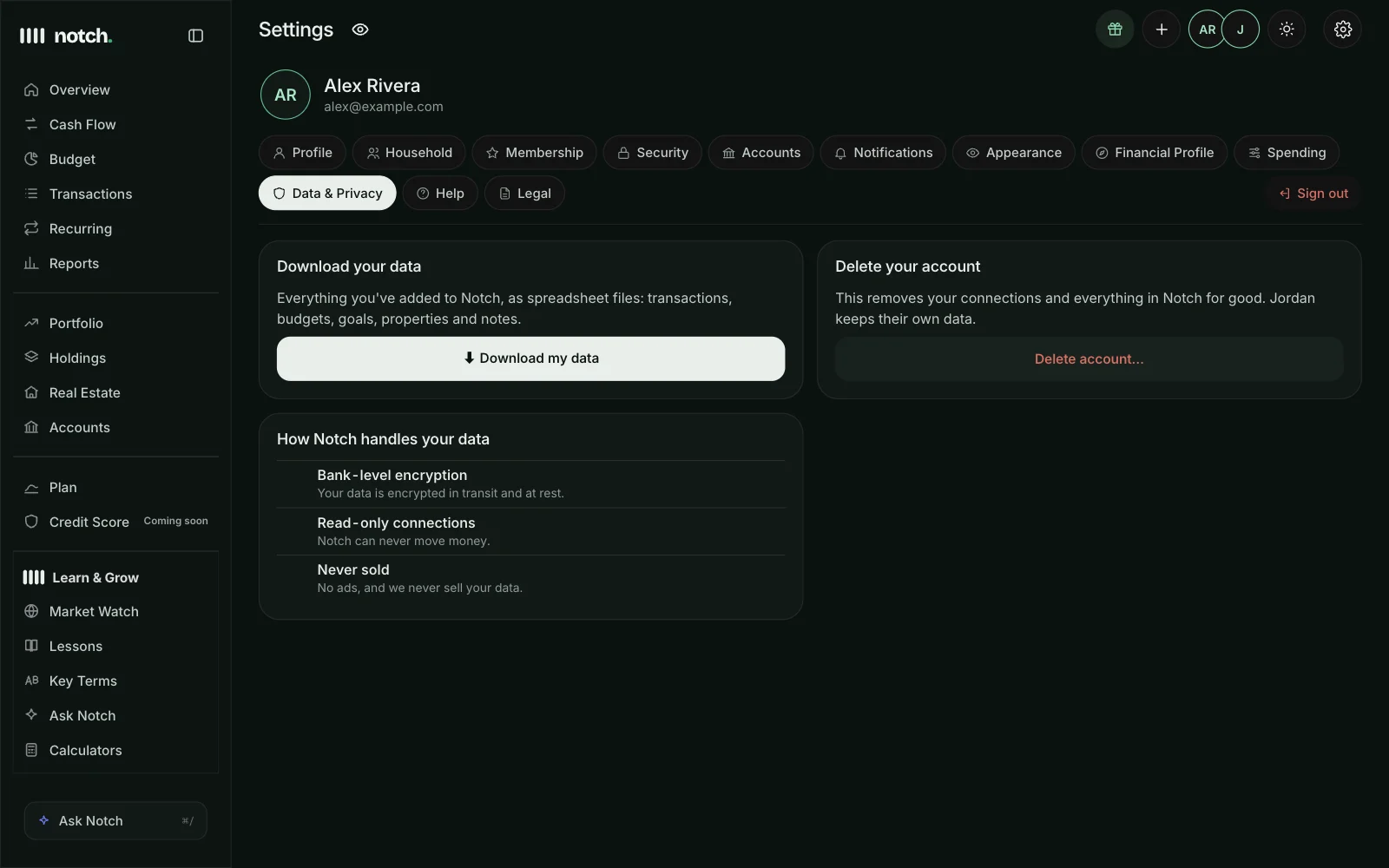
Notch can see balances and transactions. It cannot move money, pay bills, or make changes at your bank. Ever.
We never see your bank password
You sign in to your bank through Plaid, used by thousands of financial apps. Notch only receives a read-only connection.
Encrypted everywhere
Your data is encrypted in transit and at rest. Passwords are stored as salted, one-way hashes that can't be reversed.
No ads. Never sold.
You pay for Notch, so you're the customer, not the product. We don't sell your data or show you credit card offers.
Locked-down sign-in
Repeated wrong passwords are blocked, reset links expire in 30 minutes and work once, and resetting signs you out everywhere.
Leave anytime, completely
Download your data, disconnect a bank, or delete your account. Deleting erases your data and disconnects your banks.
Four steps, all read-only.
You pick your bank
Inside Notch, Plaid opens a secure window from your bank's own sign-in.
You sign in with your bank
Your username and password go to your bank, never to Notch.
You approve read-only access
Your bank shares balances and transactions. Nothing that can move money.
Notch stays in sync
Updates arrive automatically. Disconnect anytime in Settings.
What we do, and never do.
We do
- Use your data only to run Notch for you
- Encrypt it in transit and at rest
- Send only what's needed to each service that helps run Notch (Plaid, Stripe, our host and email provider)
- Limit who on our team can access systems, and log that access
- Let you download, disconnect or delete anytime
- Tell you before meaningful policy changes
We never
- Sell your data, or share it for advertising
- See or store your bank passwords
- Move money, or make changes at your bank
- Pitch you credit cards or loans
- Let AI providers train their models on your data
- Share anything with your partner you haven't chosen to share
Sharing with a partner, on your terms.
Each of you has your own login. You choose what your partner sees: everything, only shared accounts plus their own, or just totals. Your personal accounts can stay private.
Smart, not nosy.
When you use Ask Notch, automatic categorizing, or loan-document reading, we send only what that request needs. Our AI provider doesn't use it to train its models, and uploaded documents aren't kept.
Security questions, answered.
Is Notch a bank? Is my money insured?
Notch isn't a bank and never holds your money. Your money stays at your bank, with the same protections it has today, including FDIC insurance where your bank provides it.
What would happen if Notch were ever breached?
Notch doesn't store your bank passwords, and its bank connections are read-only, so they can't be used to move money. We'd notify you as required by law and tell you exactly what happened.
Can people at Notch see my information?
Access to customer data is limited to what's needed to run the service and help when you ask for support. It's protected by separate secure sign-in, and access is logged.
Can I use Notch without connecting a bank?
Yes. You can add accounts, investments and properties by hand, or connect only the accounts you want.
How do I delete my data?
Settings → Your data & privacy → Delete account. It permanently erases your Notch data, disconnects your banks, and cancels any subscription. If you share a household, your partner keeps their own data.
Where's my data stored?
In the United States, on Cloudflare's infrastructure, encrypted at rest.
Found a security issue?
We take reports seriously and respond quickly. Email us with the details, and please give us a chance to fix it before sharing it publicly.
Read the full Privacy Policy and Terms of Service.
Clarity without the trade-off.
Seven days free. Read-only, ad-free, and yours to delete anytime.